Maxing Out the Busy Season – Roundtable Key Takeaways
Q4 is usually one of the strongest periods of the year for escape rooms. That also means there’s a lot riding on a relatively short window.
For this roundtable, I wanted to focus on practical things owners can still do this quarter: Black Friday, seasonal overlays, Christmas campaigns and gift vouchers, plus how to make January a little less painful.
As usual, I kicked off each topic with a discussion starter based on what I’m seeing at clueQuest and through my consulting work, then opened the floor to owners from different markets to add their experience.
The recurring theme was simple: busy season shouldn’t mean sitting back and waiting for the bookings to arrive.
Black Friday: Participate Without Sacrificing December
Black Friday creates an obvious dilemma for escape rooms. Why discount your product just before one of the busiest months of the year?
My view is that you can participate without giving away your most valuable December capacity.
A few ways to do that:
Sell discounted vouchers that are only valid from 1 January. You capture Black Friday spending without letting customers use the discount on prime December slots.
Target quieter dates or times. If Sunday to Thursday needs help but Saturday doesn’t, build the offer accordingly.
Discount secondary products more heavily. Outdoor games, play-at-home games or other low-operational-cost products can carry the attention-grabbing offer while your core rooms stay closer to full price.
Add value instead of discounting. Merchandise, gift packs or another low-cost extra can feel valuable without eating as heavily into margin.
The important part is deciding what you actually want the campaign to achieve before choosing the discount.
Jennifer from Tactical Escape 101, for example, uses Cyber Monday to drive customers specifically into the quieter first part of December while protecting the stronger Christmas dates. Phil Harris from Pier Pressure takes the opposite approach and avoids Black Friday entirely. They run their own Purple Monday a week or two later, when there’s less noise competing for customers’ attention.
Both approaches make sense because they start with the business problem rather than the event itself.
Practical takeaway: Look at your calendar first. Identify the capacity you need help selling, then build your Black Friday offer around that. Don’t discount a Saturday in December that was going to sell anyway.
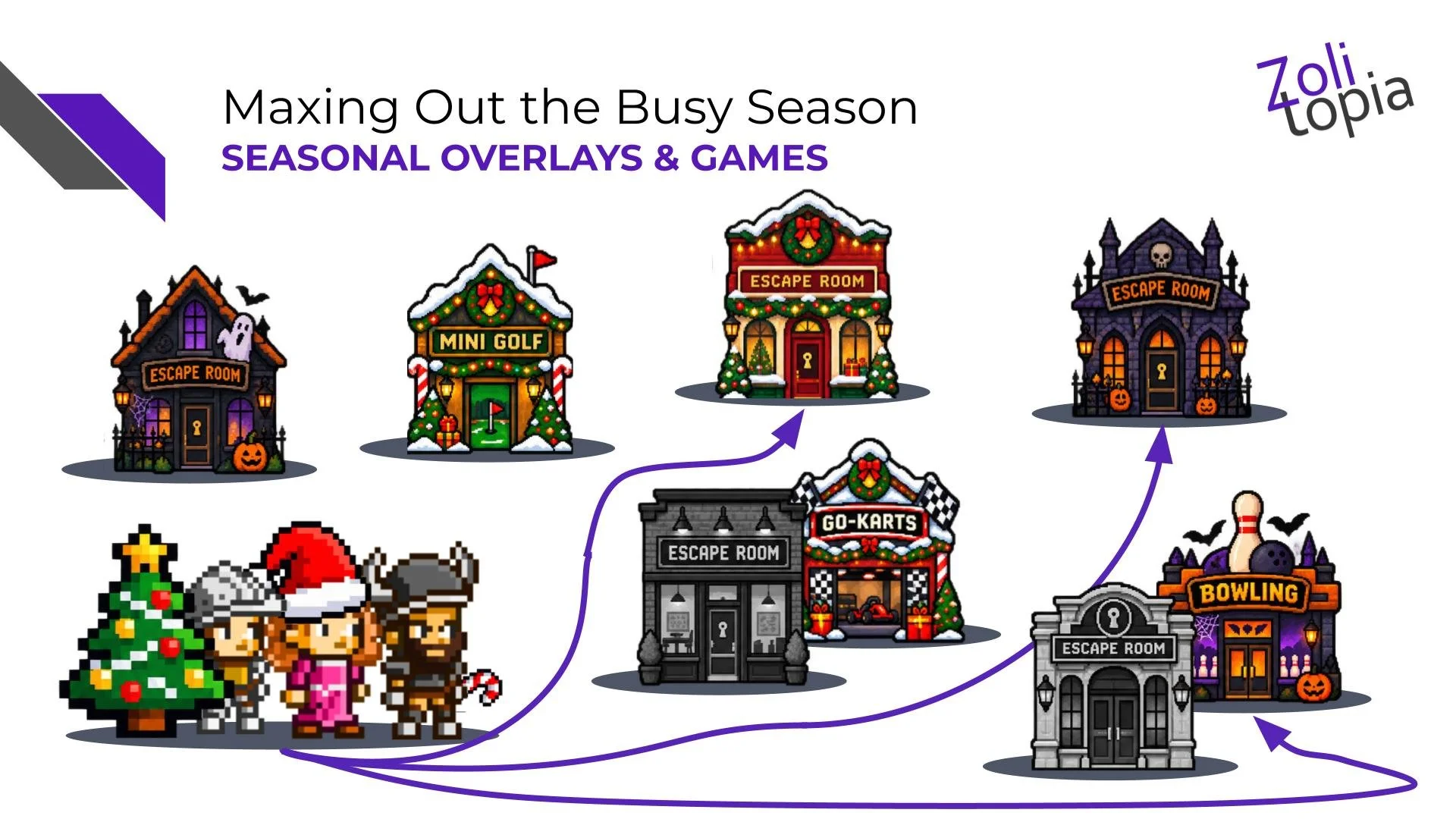
Seasonal Overlays: Sell Something New Without Building Something New
I’ve become a big believer in seasonal overlays because they give you another product to market without requiring a six-month build.
Halloween and Christmas are particularly strong because customers are already looking for seasonal things to do. Meanwhile, escape rooms are competing with mini golf, theme parks, immersive attractions, bowling, VR and pretty much every other leisure activity that suddenly discovers pumpkins in October and fairy lights in December.
You don’t necessarily need a completely new game to stay relevant.
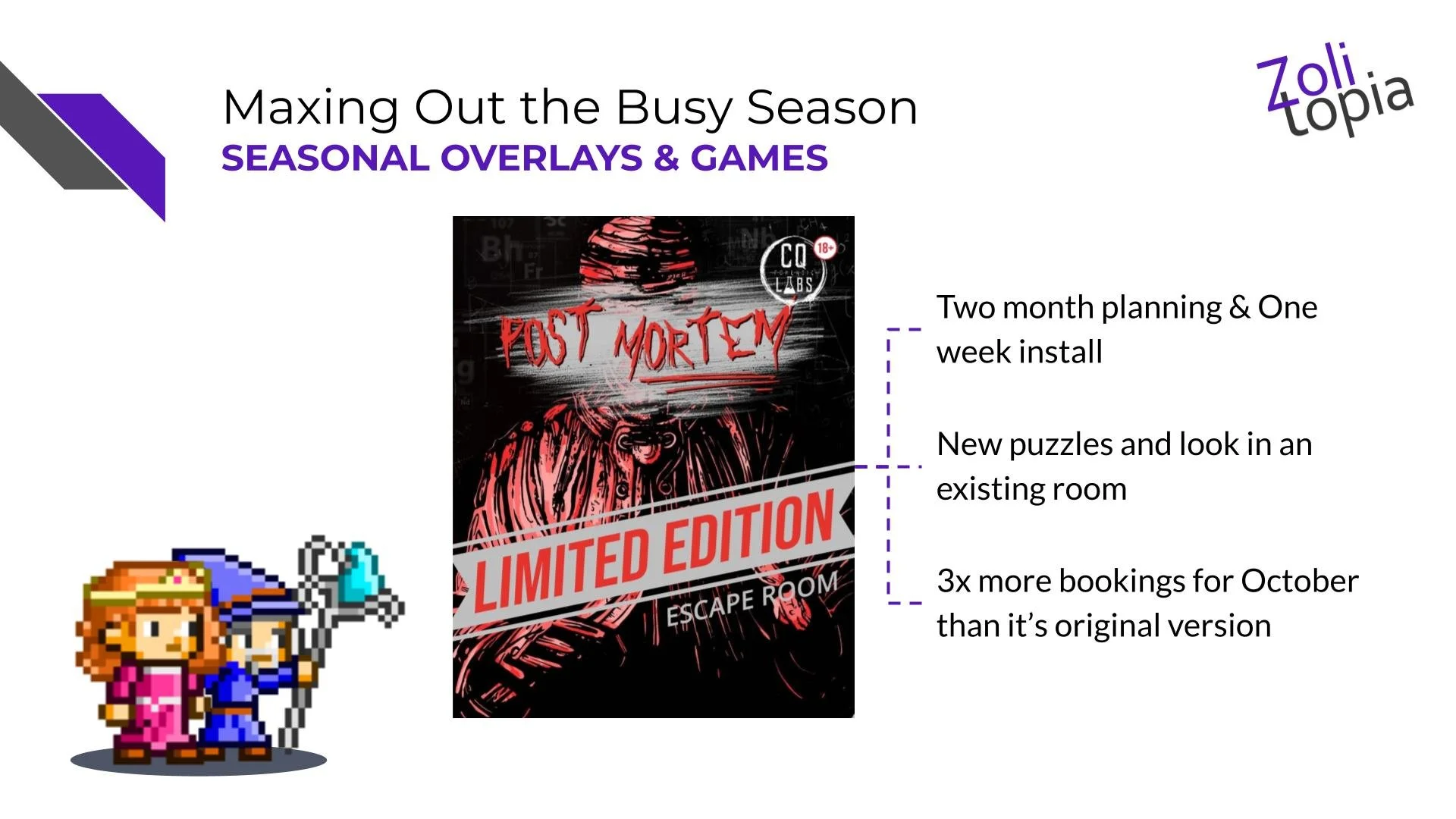
At clueQuest and with several of my clients, we’ve seen strong results from taking an existing room and changing the dressing, story or selected puzzles. One client’s Halloween overlay produced roughly 40% more revenue than the same period the previous year. At clueQuest, our new Halloween experience generated significantly stronger October demand than the standard version of the room it temporarily replaced.
The roundtable added some particularly useful variations to this.
Adam Buick has gone as far as designing reversible wall panels into his new rooms, allowing the venue to switch between standard and Christmas games in a matter of hours. Phil is building up a library of Christmas overlays that can be stored and brought back each year. His longer-term plan is eventually to be able to convert all eight permanent games for the season.
Krisztina from MindMaze offered the easiest version of all: don’t change the room, change the venue. They heavily decorate their reception areas and create photo opportunities. Customers take pictures, tag the company and generate seasonal social content without the team having to redesign a single puzzle.
There’s also a useful testing opportunity here. Brandon shared an example of a temporary Halloween version becoming so much more popular than the original theme that the operator eventually kept it permanently.
Seasonal overlays can therefore do three things at once: generate short-term revenue, give your marketing something fresh to talk about and test ideas without committing to a full rebuild.
Practical takeaway: Pick one existing product and ask how far you realistically want to go:
Full seasonal game with new puzzles
Same room with a new story and dressing
Small seasonal layer or scavenger hunt
Seasonal reception and photo area
You don’t have to go all-in for it to be worthwhile.
Christmas Marketing: Planning Beats Panic
The least exciting part of the roundtable involved spreadsheets.
Unfortunately, spreadsheets make money.
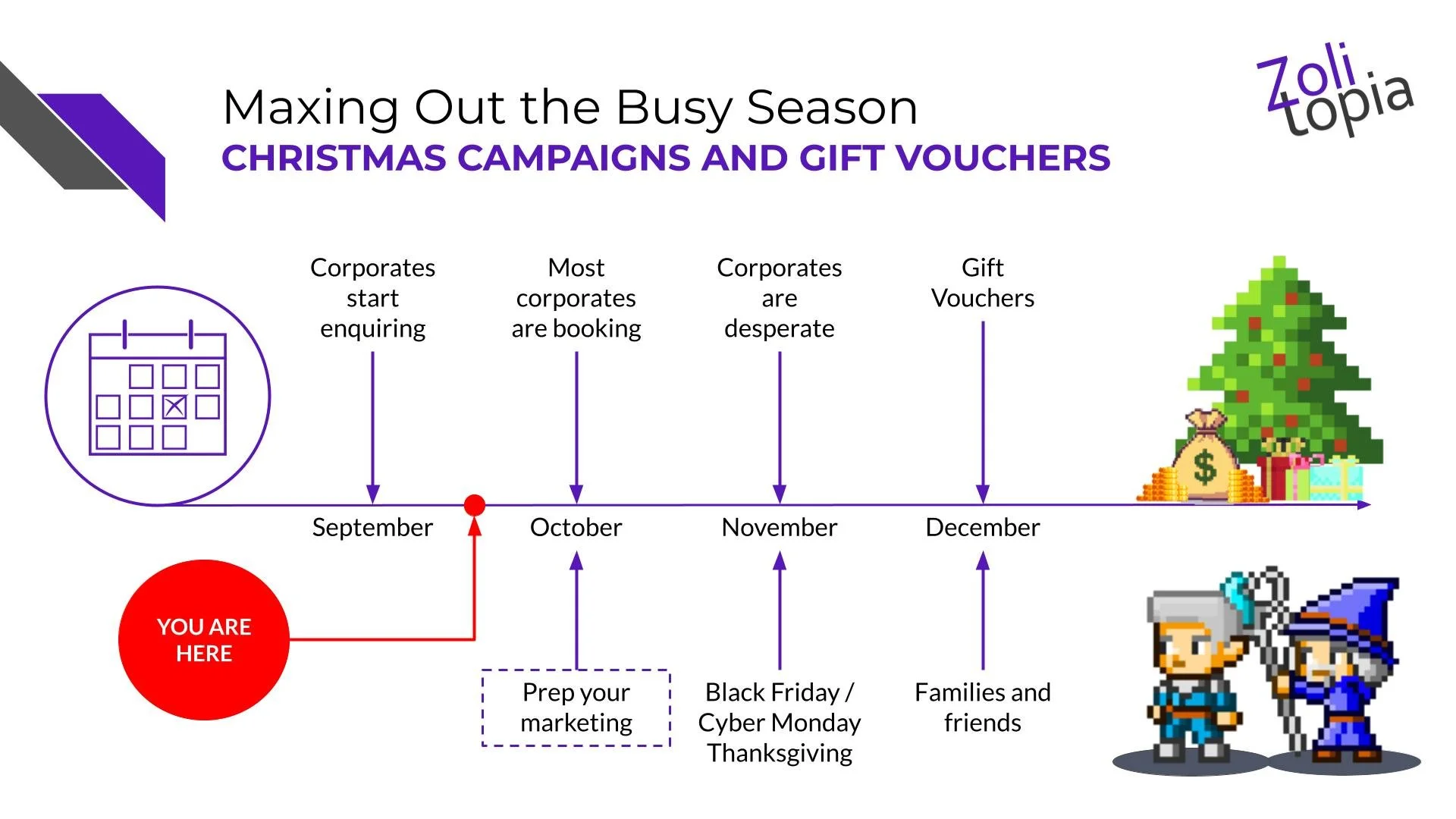
If you wait until December to start thinking about your Christmas campaign, you’re already late. By October, I want owners thinking about four things: staffing, capacity, marketing and offers.
Corporate bookings are particularly important. Enquiries start early, and there are usually a handful of December dates everyone wants.
Be careful about letting small online bookings fragment those dates if you have the capacity to take larger groups. Sometimes it makes more sense to hold certain times for corporate enquiries and manage them through a direct sales process.
You should also review how much capacity you can realistically create. At clueQuest, December means peak pricing and tighter timetables where the operation allows it. Even one additional game per room per day can become meaningful when multiplied across several rooms and several weeks.
Then there’s the actual campaign.
I like to plan Christmas marketing in advance across email, social and paid advertising, with a clear lead message and supporting message for each piece of communication, but I won’t bore you with this here, I covered this topic in another Christmas campaign focuesd blog.
Gift Vouchers: Make Them Feel Like a Present
Gift voucher performance varies massively by market, so I wouldn’t treat anyone else’s numbers as a universal benchmark.
Victor from Sherlocked (Netherlands) pointed out that Christmas vouchers simply aren’t as culturally important in his market. Krisztina described the opposite experience in Prague, where Christmas voucher sales can effectively feel like an additional month of revenue.
That difference is exactly why context matters.
If vouchers already work for you, though, there are several ways to improve them.
Krisztina showed some beautifully designed physical vouchers themed around individual games. Customers could download a normal voucher immediately, but many still chose to pay extra for something that looked and felt like a proper gift.
That distinction matters.
A PDF is convenient. A beautifully presented physical voucher is a product.
If you’re pushing vouchers this Christmas:
Make the checkout as quick as possible.
Offer instant delivery.
Make sure the printable version doesn’t look terrible.
Consider a premium physical option.
If you discount vouchers, consider making them valid from January.
Plan several reminders rather than sending one “BUY VOUCHERS!” email on 20 December.
Your Team Is a Sales Channel Too
One of the easiest opportunities is already standing at reception.
A customer has just finished your game, they’re excited, and your game master has a direct relationship with them. That is a much warmer sales opportunity than almost anything you can buy through Meta or Google.
Krisztina explained that their team receives actual sales training rather than simply being told to “upsell more”. They use scripts, roleplay the conversations and give staff a small financial incentive for successful sales.
Others in the discussion use similar bonuses for same-day rebookings, merchandise and larger upsells.
It doesn’t have to feel pushy. Often it is as simple as:
“If you enjoyed this one, have you seen what we’re doing for Christmas?”
Give your team something worth selling, show them how to introduce it naturally and consider letting them share a little in the upside.
Don’t Wait Until January to Think About January
January can be unpredictable. Sometimes ours is surprisingly strong; sometimes it very much remembers that it’s January.
There are a few things you can set up during Q4 to soften the drop:
Corporate bookings: some companies deliberately move their Christmas events into January. If you can’t accommodate their preferred December date, offer January rather than simply losing the enquiry.
Extend the seasonal experience: run your Christmas game into the first week of January with a “last chance to play” campaign.
Activate voucher holders: remind December voucher recipients to book. They may bring additional players, spend more on-site and help fill otherwise quieter capacity.
None of these will magically turn January into December, but that isn’t the goal. You’re simply carrying more momentum across the line.
The Bigger Takeaway: Stack the Small Wins
There wasn’t one revolutionary idea in this roundtable, and I actually think that’s what makes this topic useful.
A stronger Black Friday restriction, one seasonal overlay, an extra December slot, better voucher emails, a game master who rebooks another team, and one corporate group shifted into January may all look relatively small on their own.
Together, they can make a meaningful difference to the quarter.
And importantly, most of them don’t require you to rebuild your business between now and Christmas.
If you’re looking at all of this and wondering which two or three things would actually make the biggest difference to your business, that’s exactly the kind of work I do through Zolitopia. My advisory work helps escape room owners step away from constantly reacting to what’s happening now and build a clearer plan for where the business should go next.
Pick the two or three ideas that make sense for your venue, put them into action and measure what happens.
The busy season is coming either way. You might as well make the most of it.
Want More Conversations Like This?
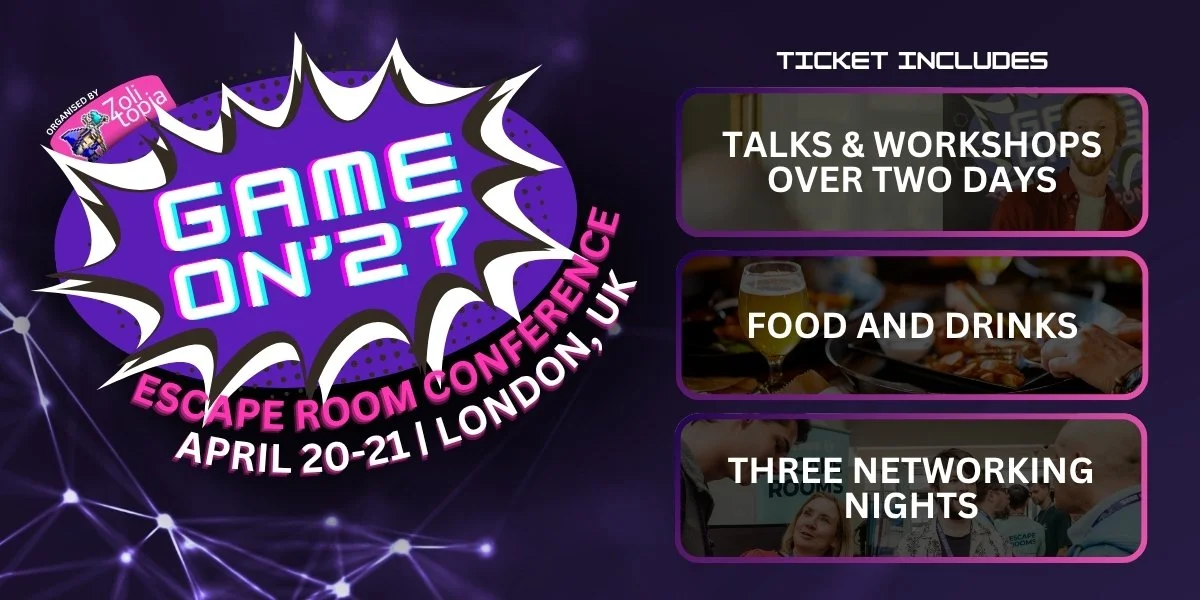
Game On returns to London on 20–21 April 2027, bringing escape room owners and professionals from around the world together for two days of talks, workshops and plenty of time to swap ideas with people who actually understand this weird little industry.
Read More Blogs