At ER Champ this year, I was given a slightly unusual challenge. Instead of just turning up with another presentation, the organisers found an escape room business that was struggling and asked me to work with the owner for eight weeks.
The challenge was simple enough to explain: can you fix an escape room business in eight weeks?
The business belonged to Peter, who operates two escape room venues in Warsaw. When we started working together, bookings at his original location had fallen badly, his attention was consumed by building a new game, marketing had become reactive, and he was mostly putting out fires.
Eight weeks later, October bookings were back in line with the previous year and it became his third strongest month in the previous two years.
So, did we fix the business? Sort of. We definitely course corrected it. And I think the process is useful far beyond Peter's particular situation.
Don’t have the time to watch it or prefer reading? TL;DW version 👇
The Market Has Changed
Before looking at Peter's business, I wanted to establish one thing: escape rooms aren't the new thing anymore.
In the early 2010s, we practically were the immersive entertainment market. Today, customers can choose between challenge rooms, immersive mini golf, projection-mapped darts, VR, axe throwing, game shows, Mario Kart style go-karting and a growing number of other concepts.

Escape rooms are now an established leisure product. (The Future of Escape Rooms - 2026 Edition) That's not a bad thing, but it does mean that opening your doors and waiting for word of mouth to do the rest isn't much of a strategy anymore.
And when bookings start dropping, one of the industry's favourite reactions is to build another room.
Sometimes you do need a new room. But a new room doesn't fix a broken website, poor marketing, weak operations, the wrong pricing or an owner who is trying to do everything themselves.
That was exactly the problem we needed to diagnose here.
Think of Your Business Like a PC
To diagnose Peter’s business, I used a framework I developed and now use with all of my consulting clients to identify both problems and growth opportunities. It’s slightly nerdy, but bear with me: imagine your escape room business is a computer.
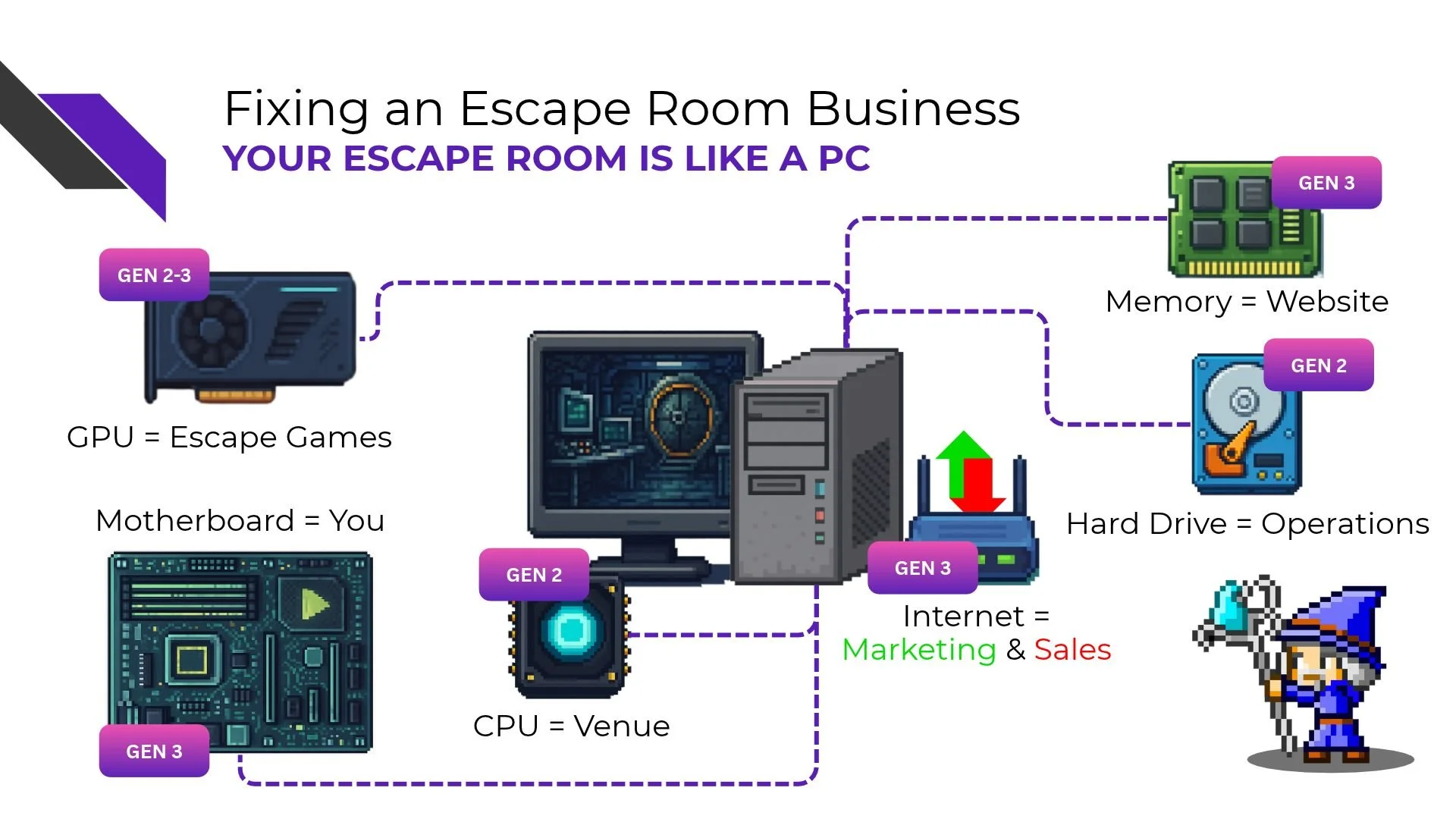
Each component represents a different part of the company:
GPU – Your games: the actual experiences you're selling
CPU – Your venue: the physical space everything operates through
Memory – Your website: where customers process information and decide what to buy
Hard drive – Your operation: your systems, manuals, processes and ways of working
Internet connection – Marketing and sales: how effectively the business connects with potential customers
Motherboard – You: the owner holding all of this together
I then loosely categorise each area from Gen 0 to Gen 3.
Gen 3 doesn't mean "perfect forever". Quite the opposite. Technology moves on, and what qualifies as Gen 3 today eventually becomes Gen 2, then Gen 1.
Businesses work the same way.
The framework simply gives me a way to look at a company and quickly identify where the weakest component is holding everything else back.
What Was Actually Wrong?
Peter's venues themselves were reasonably solid. They were clean, presentable and doing their job, so there wasn't much reason to spend our limited eight weeks changing them.
The games were mixed. Some needed maintenance and improvement, but rebuilding escape rooms is slow and expensive, so that wasn't going to be our quickest route to recovery either.
The bigger problems were elsewhere.
The website
The existing websites had outdated information, obvious AI imagery, too much text and difficult navigation. The biggest issue was fairly simple: they didn't make me particularly excited to buy anything.
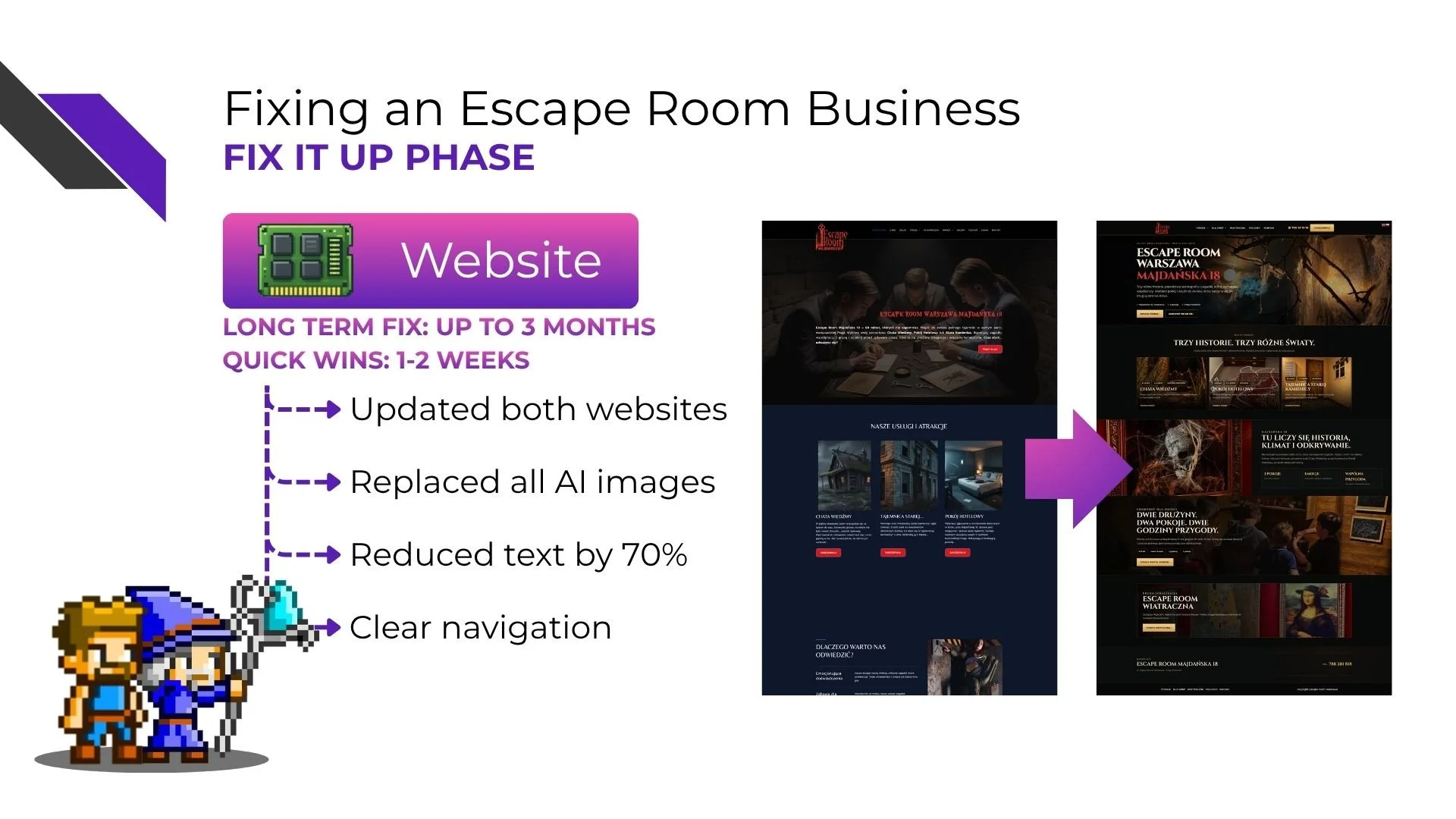
Peter happens to be very capable with websites, so after I gave him a detailed list of changes, examples and a new structure, he rebuilt both sites remarkably quickly. We replaced the AI imagery with real photographs of the rooms, simplified the pages and made the booking journey much clearer.
And no, you don't necessarily need an expensive photoshoot. The new room photographs were taken on a phone.
The team
Peter had a small team primarily focused on running games. There wasn't much additional responsibility being distributed, and the staff weren't particularly engaged with what was happening in the wider business.
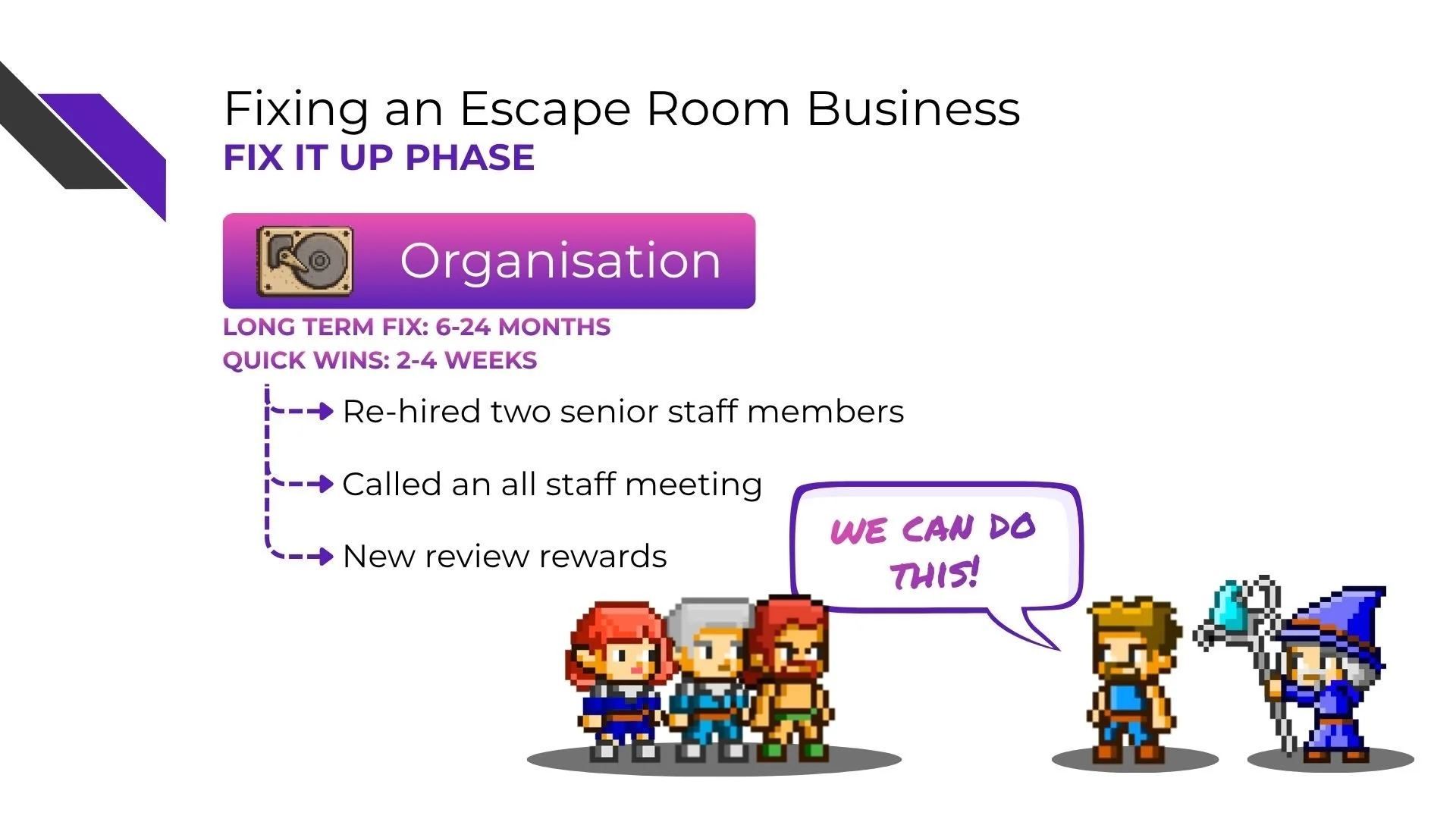
That isn't unusual in small escape room companies, but it creates a problem. If everyone's job is just to run a room and go home, you're wasting a lot of potential talent.
We brought senior staff back into the picture, held a structured team meeting, explained the turnaround plan and introduced a review incentive. This wasn't going to transform the organisation in eight weeks, organisational change usually takes far longer, but it started moving the team in the right direction.
Marketing and sales
This was the biggest problem.
Peter had Google Ads running, but proper conversion tracking wasn't in place. Social media existed, but there was little engagement. There was no newsletter. And most importantly, there wasn't a clear plan for how the business was going to sell what it already had.
Peter had been concentrating on building his new room. Meanwhile, thousands of previous customers were sitting in his database hearing absolutely nothing from him.
That's where we focused most of our attention.
Sell What You Already Have
One of the first things we discovered was that Peter had 3,410 email addresses sitting unused. So we started emailing them.
The first newsletter achieved an open rate of around 40%, and the next one reached 46%. Suddenly, Peter had a direct channel to thousands of people who already knew the business but hadn’t heard from it in a long time.
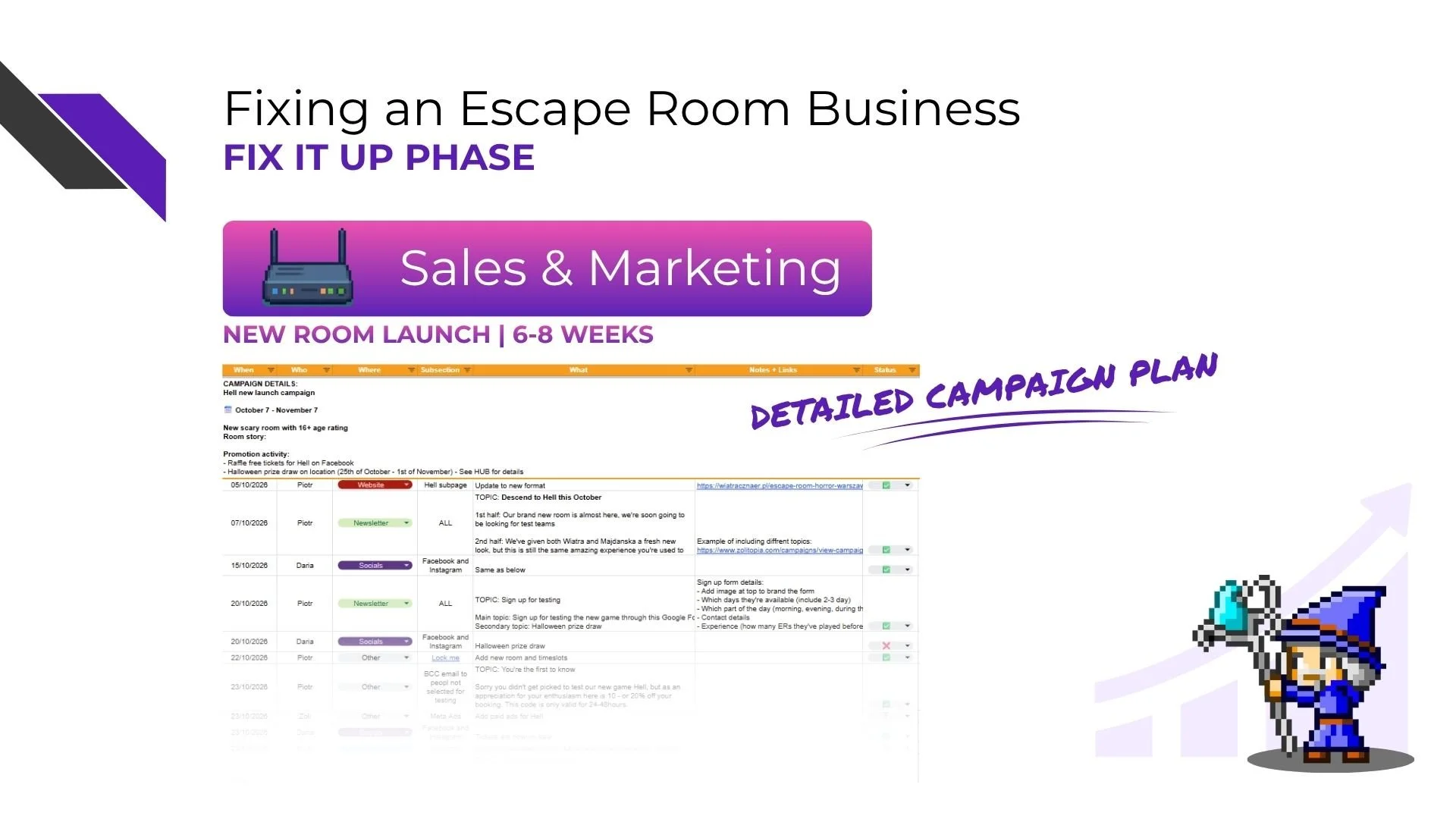
We then built a proper campaign around the upcoming new room, with clear responsibilities, channels and promotions mapped out in advance rather than invented on the fly. The response was strong: more than 100 test teams signed up and the opening weekend completely sold out.
Then the room launch got cancelled.
Not ideal.
But here’s the important part: despite that, bookings across the existing rooms were strong.

That was the real proof that the work was doing something. The marketing wasn’t only selling one new product, it was putting the whole business back in front of people again.
That’s why I keep coming back to the same point with owners: before assuming you need another expensive build, make sure you’re actually doing a good job of selling what you already have.
Marketing Without Tracking Is Guessing
Alongside the wider strategy, I brought in my marketing agency, beboldR, to sort out the paid side.
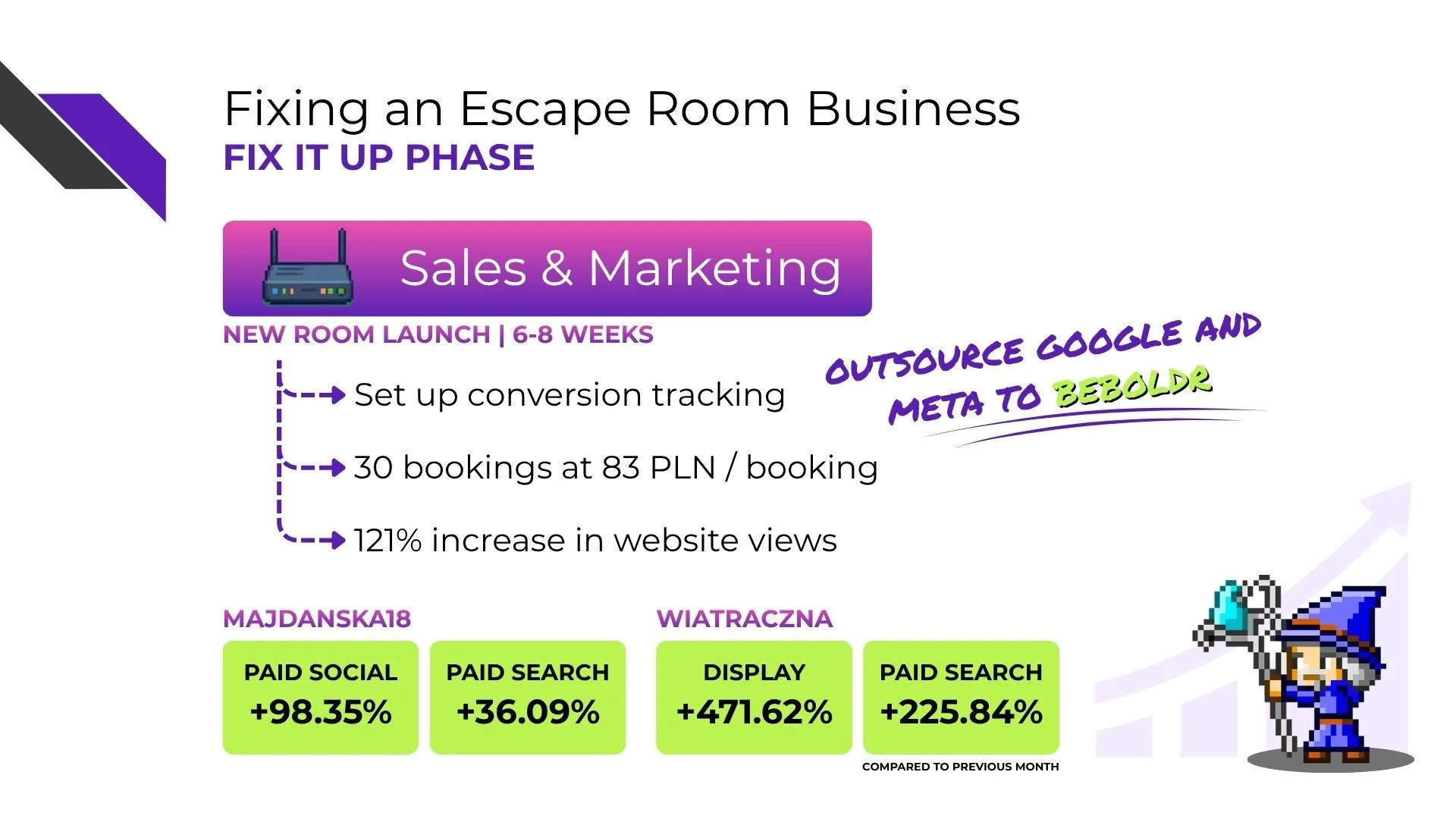
The first priority was conversion tracking. Peter had already been spending money on Google Ads, but couldn't properly see what those ads were producing.
That's a dangerous position to be in because you don't know whether your ads are brilliant, terrible or somewhere in between. You're simply sending money into the internet and hoping some bookings fall out.
Once tracking was in place, we could actually measure results. In October, we attributed 30 bookings directly to Google Ads, while overall website traffic increased significantly compared with the previous month.
The lesson here isn't simply "run Google Ads". It's much broader:
If you're paying for marketing, make sure you can measure what it's doing.
Otherwise, optimisation is mostly guesswork.
We Changed the Pricing Too
The booking data uncovered another interesting problem, teams of two accounted for roughly a quarter of Peter's bookings. That told me customers were already willing to pay considerably more per person than the pricing structure suggested.
Yet, teams of three and four were paying the same overall amount. So we raised the prices.
Price increases always make owners nervous. I've done this plenty of times and I still have the little voice asking, "What if this is the time everyone suddenly stops booking?"
They didn't.
From September to October, bookings increased by 68%.
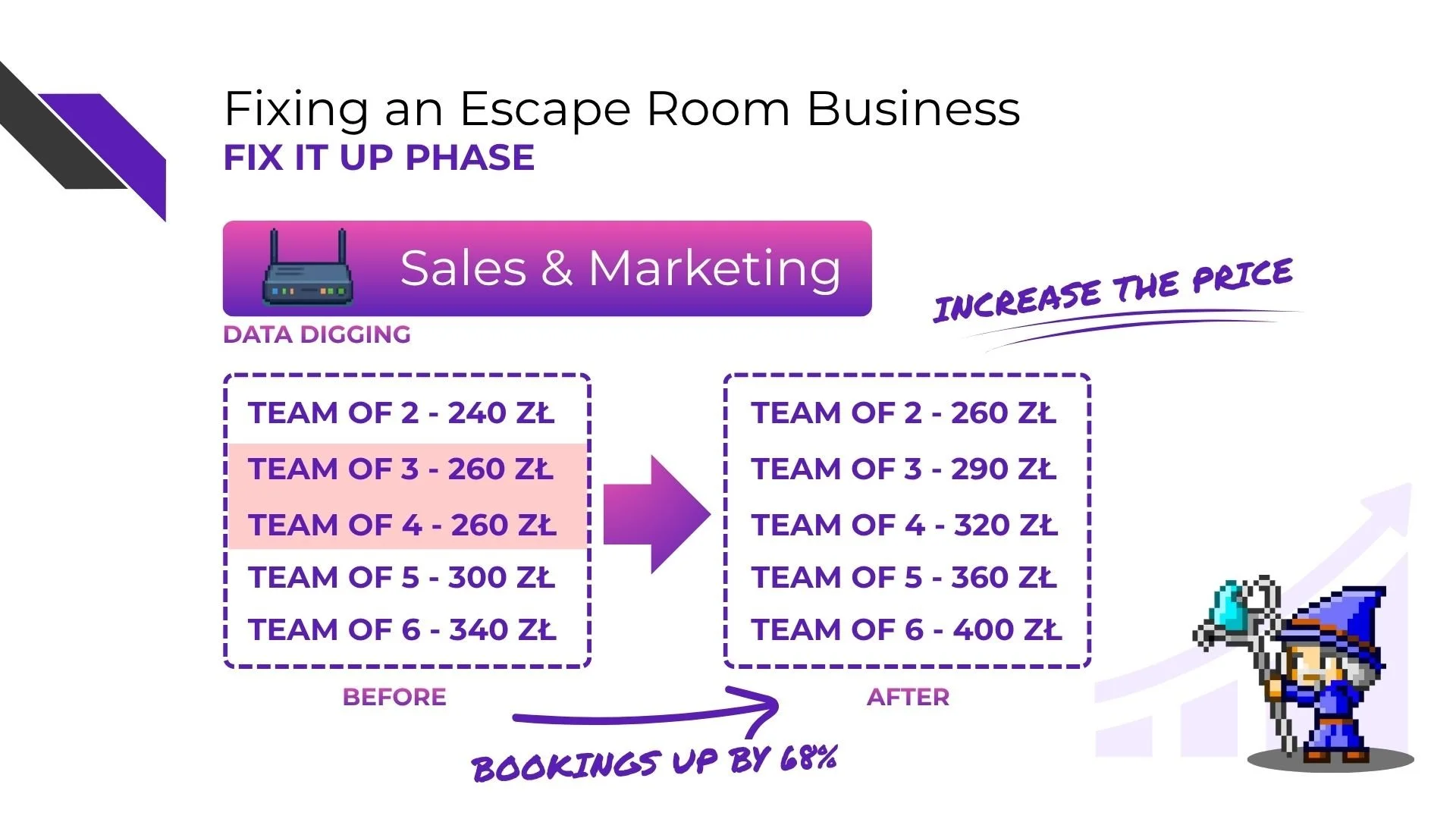
Seasonality obviously played a role, so I'm not pretending the pricing change created that growth. The important thing was that raising the prices did not cause demand to collapse.
Sometimes the cheapest thing you can do is stop undercharging.
Eight Weeks Later
When we started, some months had been down around 40% across the business, with the original location performing considerably worse.
By October, bookings were back to roughly the previous year's level, and it became Peter's third strongest month in the previous 24 months.
More importantly, there was now a plan.
The website was dramatically stronger. Marketing was organised. A newsletter existed. Paid campaigns were trackable. Pricing made more sense. The team had been brought into the turnaround, and Peter wasn't simply waking up every morning wondering which fire needed putting out first.
That is what I mean by course correction.
You may not completely rebuild a business in eight weeks, but eight weeks is absolutely enough time to stop heading in the wrong direction.
What Does a "Gen 3" Escape Room Business Look Like?
The final part of the talk looked beyond Peter's immediate turnaround.
If Gen 3 represents a strong escape room business today, what does that actually mean?
Your games stay fresh
A good room isn't finished on opening day.
Paint gets chipped. Props deteriorate. Technology dates. Expectations change.
Maintain the rooms before things break, refresh them regularly and keep improving the experience. Your oldest game shouldn't feel like your oldest game.
Seasonal overlays and limited-run versions can also create something new to market without requiring a complete rebuild every year.
Your venue works harder
Rent isn't getting cheaper, so if you've got spaces sitting empty, ask what else they could do.
At my business in London, one of our conference spaces transforms into a TERPECA Nominee escape game. Other operators rent their sets for filming, use rooms for parties or create flexible spaces that change with the season.
Think in terms of square metres earning money, not just rooms with fixed labels.
Your team has somewhere to grow
Talent management isn't something reserved for corporations with HR departments.
Even with a team of five, you can give people additional responsibilities. Someone can own customer care, someone can manage social media, someone can take responsibility for maintenance, and someone can train new staff.
Those responsibilities take work off the owner's plate while giving employees a reason to become more invested in the business.
Your website is never "finished"
If you haven't changed anything on your website for six months, have another look.
Something will be outdated, something will be confusing, and something can probably convert better.
Keep navigation simple, use real photography, move detailed information into useful FAQs and create landing pages for specific audiences rather than insisting that one generic page works for everyone.
Corporate groups aren't looking for the same thing as families. Schools aren't looking for the same thing as tourists.
Talk to them separately.
Your marketing has a budget and a purpose
The days when escape rooms could rely entirely on organic word of mouth are largely behind us.
You need a marketing budget, but more importantly, you need an acquisition strategy.
Don't just say, "We need more bookings."
Be more specific:
We want more corporate bookings, and this is how we're going to reach HR managers
We want more school groups, and this is how we're going to reach teachers
We want more families, and this is how we're going to reach parents
We want more teenagers, and this is how we're going to make the product relevant to them
Use your own channels — website, newsletter, social media and venue — alongside paid advertising, partnerships and other opportunities relevant to your market.
The owner isn't doing everything
This might be the most important one.
The industry now has suppliers, specialists and experienced professionals covering almost every part of running an escape room company.
Use them.
Owners trying to do absolutely everything themselves was understandable in 2013. It's much harder to justify now.
A mature business shouldn't depend on the owner being the best marketer, web designer, maintenance person, recruiter, salesperson, game designer and customer service representative simultaneously.
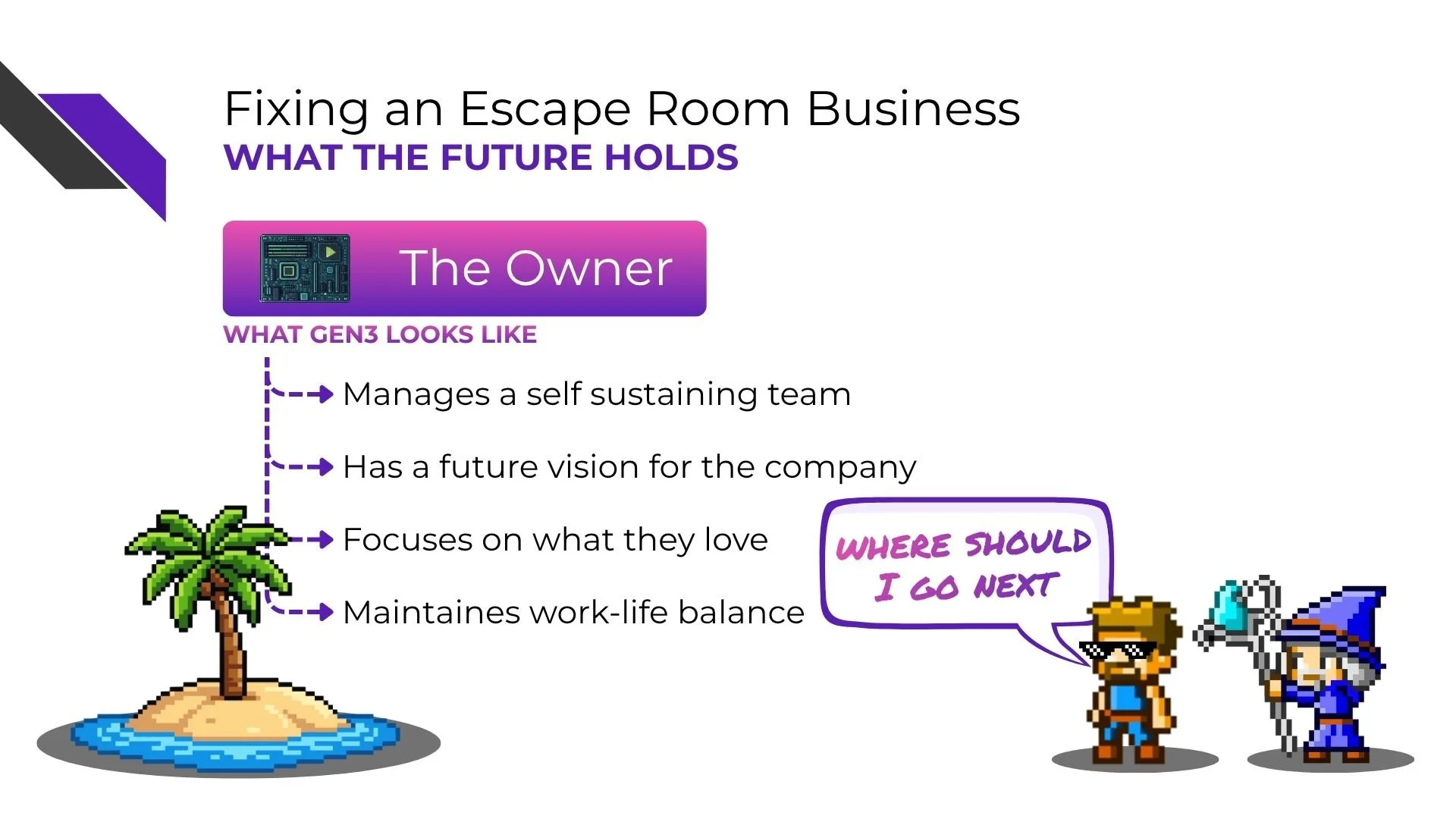
A Gen 3 owner has a team around them, knows where the business is going and spends their time on the parts of the company where they add the most value — ideally including the parts they actually enjoy.
So, Can You Fix an Escape Room Business in Eight Weeks?
You can absolutely course correct one.
Some problems take longer. Replacing the wrong people, rebuilding an organisational structure or developing genuinely new products can take months or years.
But eight weeks is plenty of time to identify what's actually broken, establish priorities and start moving the numbers in the right direction.
And that's probably the biggest lesson from this experiment.
When bookings fall, don't immediately disappear into the workshop and start building another room. Zoom out first and look at the whole machine.
Ask yourself:
Are the games actually the problem?
Is the venue holding you back?
Is your website converting?
Are your operations slowing you down?
Is your marketing organised and measurable?
Or are you, as the owner, trying to hold too much together yourself?
Fix the weakest parts first.
Because what counts as a great escape room business keeps changing. Today's Gen 3 will eventually become tomorrow's Gen 1.
The escape room industry isn't disappearing. After almost two decades, I think we've earned the right to stop treating it like a temporary trend.
But the businesses within it still have to evolve.
The question isn't whether escape rooms will still be here.
The questions is, whether you're going to keep up with them.
Need a Course Correction?
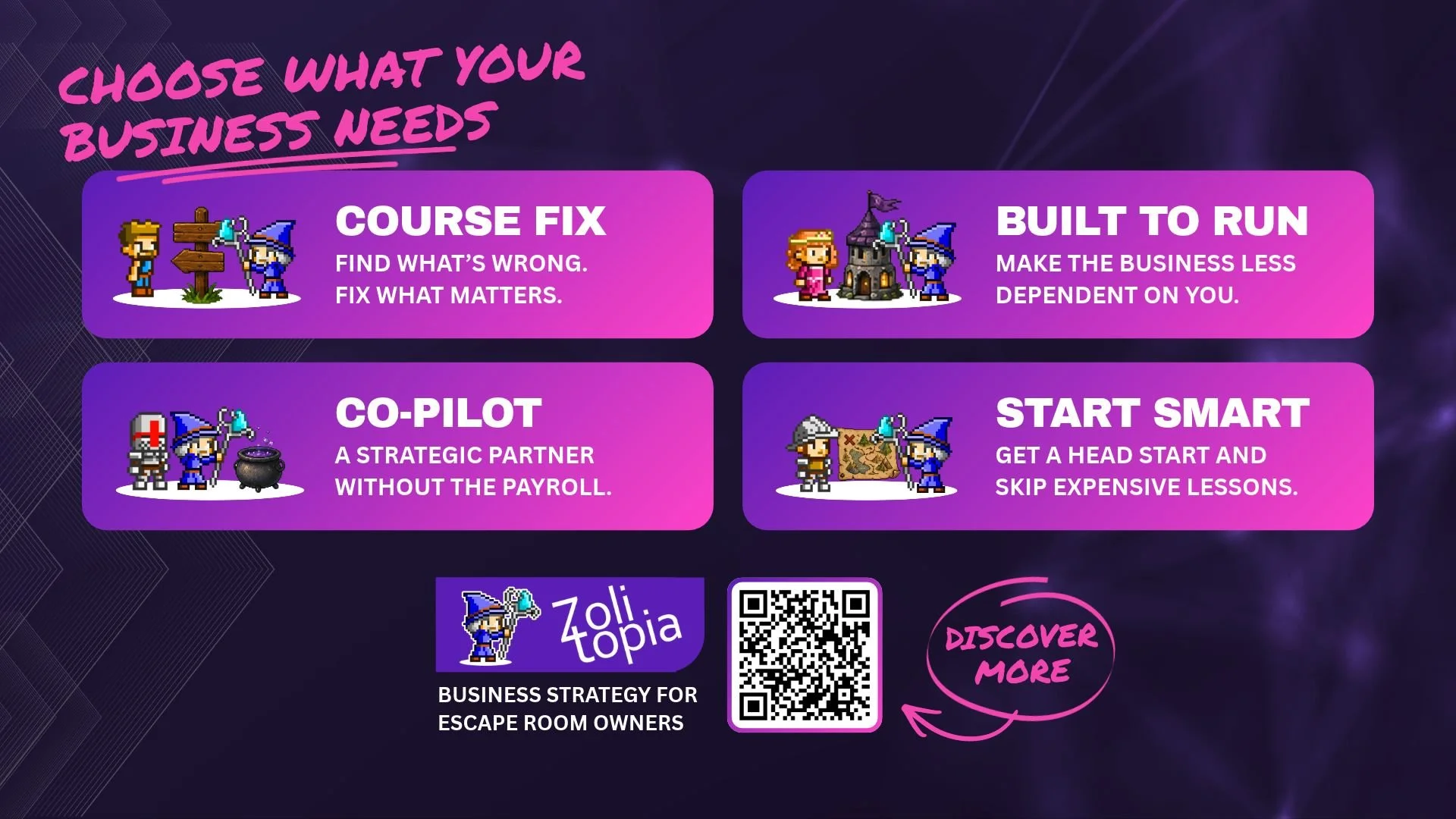
If you're looking at your own business and thinking, "I know something isn't working, but I'm not sure where to start," this is exactly what my Course Correct advisory work is built around.
I help escape room owners diagnose what's holding the business back, prioritise the changes that will have the biggest impact and build a practical plan to move forward — without automatically assuming the answer is another expensive room build.
If that sounds familiar, get in touch and let's have a chat.
Read More of My Blogs